
ISPAD Newsletter - March 2026
ISPAD's March Newsletter is now available with exciting news including ISPAD 2026 abstract submission, ISPAD Fellowships and Prizes, and much more! Click here to access to our latest news:
President's Message:
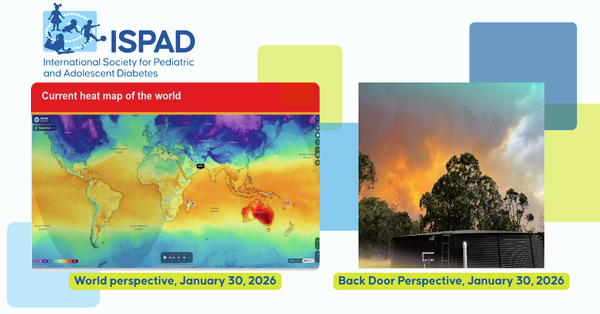
Where I live, summers can be rather warm. We often have bushfires. Some years are worse than others. This summer was one of the bad ones. Many farms, houses and livestock were lost. In the aftermath there is always discussion around re-building and what insurance will and will not cover. My cousin’s (owner of the back door in the above photo) local town was all but wiped off the map by one of this year’s fires. He made the comment that insurance might replace buildings and machinery, but it can never replace a person’s “sweat equity”. By this he meant the amount of effort over the years that farmers in particular had put into building up the quality their farms, animal stock, fruit trees or crops. Decades of environmental stewardship, selective genetics, aboriculture or soil improvement gone in an instant and unable to be replaced in a human lifetime.
According to the Warren Buffet (the ‘Oracle of Omaha’), the eighth wonder of the world is compound interest. The long term benefits of an investment showing exponential growth over time. They key is to start early. Many of us have retirement plans that depend on superannuation or retirement savings systems that are predicated on compound interest. When you think about it, diabetes is a bit like a superannuation scheme. The greater the investment that is committed early in the piece, the greater the subsequent health rewards. I would argue that the investment currency in diabetes superannuation is sweat equity. By this I mean all of the daily micro-efforts made by our patients and their families. Getting that bolus right, changing that injection site, responding to that alarm, following up on that diabetes educator contact, keeping a clinic appointment etc. Each effort might be a just a brief moment, but over time they add up. It seems that metabolic outcomes in early life casts a disproportionately longer shadow in terms of later-life outcomes. Thus, the return on good outcomes in childhood, adolescence and young adulthood ‘compounds’ into a greater health nest-egg.
However, as we all know, not every young patient is a willing investor. Fun fact for movie buffs- the actor Dick Van Dyke turned 100 last December. In the well-known movie Mary Poppins, his character’s coercion of a young person to invest in The Fidelity, Fiduciary Bank ends with the reluctant investor screaming “Give me my money”, triggering a run on the bank. So, I guess the trick then is relying on willing investors to contribute sweat equity in diabetes care. Early in life this levy falls to adult care-givers. The skill in adolescent and young adult care is deciding when to start directing the sweat equity invoices to the patient themselves. As with most things in life, timing is everything. A run on the bank of clinical care by a reluctant investor usually results in disengagement, non-adherence or loss to follow up. Setbacks in diabetes in youth often accompany mental health issues. More often than not, poor mental health is accompanied by suboptimal self-care which may last years (stay tuned for updated psychological care guidelines later this year!). Unfortunately, as with environmental cataclysms there is no insurance policy that can protect against the loss of acquired sweat equity at these times. It would appear then that the greatest defence is to have as much in the bank as possible so, if there is a transitory period of sweat equity withdrawal, the balance remains robust.
Notwithstanding bushfires, the world needs more trees. According to the Chinese proverb “The best time to plant a tree was 20 years ago. The second-best time is now”. It is never too late to put effort into diabetes self-care. However, the sooner the better.
Best to all,
Fergus