ISPAD Newsletter - September 2026
ISPAD's September Newsletter is now available with exciting news. Click here to access to our latest news:
President's Message:
The last year has been rather busy for your Executive Board.

Expected and foreseen
As we indicated at last year’s Annual General Meeting, we have decided to move ISPAD’s legal and financial home from the UK to Austria. The reasons for this were outlined both at the AGM and in the preceding newsletter (October 2025). Things have gone to plan and ISPAD is now a registered charity in Austria. We have also appointed Austrian legal representation and accountants, and opened an account in ISPAD’s name with Erste Bank. ISPAD is now operating out of Austria for all new and renewing activities. However, given that we are also a listed charity in the UK, the exit process is complex. This may take up to 12 months and in the interim we will be legally present in both countries.
Unexpected but foreseeable
A proportion of ISPAD revenue is spent on association management and conference organisation. For the last 20 years K.I.T. Group has been both ISPAD’s AMC (Association Management Company) and PCO (Professional Conference Organiser). In this last decade in particular, ISPAD’s activities have grown significantly both in depth and breadth. This has place considerable strain on the historical resource allocation for secretariat support negotiated between ISPAD and K.I.T. Group. This resulted in ongoing discussion and re-negotiation as far back as March 2025. Unfortunately, interim solutions have proved unsustainable and the difficulties have continued. Things came to a head at the Winter EB Meeting in March 2026 when it became apparent that there needed to be a major change in resource allocation. This coincided with existing contracts coming up for review. Given the significant financial implications for ISPAD, the EB felt the responsible course of action was to ‘test the market’ and ask for RFP’s (Request for Proposal) for the AMC and PCO contracts from K.I.T. Group and other providers. The RFP process concluded in June 2026. This process has allowed for a re-imagining of what our future relationship with a secretariat might look like, taking into account novel approaches that will facilitate the function of our various committees and special interest groups. A stipulated key metric was that any change should be minimally disruptive to ISPAD members. We interviewed a total of five companies and then reinterviewed the two we felt were the best fit for ISPAD. We decided that moving forward, our best interests would be served by a new company, C-IN. C-IN is a Czech based entity that deals with many medical societies similar in size to ISPAD. Its particular strength is in digital innovation which we felt is an important consideration for ISPAD given our platforms of education and advocacy. C-IN will commence the AMC role in January 2027 and the PCO role after the 2027 Scientific Meeting.
Unexpected and unforeseeable
The world remains an uncertain place. For the last 10 years ISPAD has had a policy ensuring enough deposited reserve money to cover the possibility of any financial ‘failures’. Specifically, enough is kept in reserve to cover the unlikely possibility of two annual scientific meetings running at a loss. Prior to this year’s Winter EB Meeting our three reserve accounts with our Bank were routinely checked by our Treasurer. All was well. During the meeting itself, we decided to re-check the accounts for reasons related to the new RFP process. To our horror we discovered that our three accounts with our Bank had all been closed and the deposits were not locatable. It was unclear at the time why this had occurred and all possibilities were considered and immediately acted upon. It took some time to achieve effective communication with our Bank. Over the subsequent weeks we discovered that as part of their “Know Your Customer” legal obligations, our Bank had sent letters to our Secretariat office in Berlin in the last quarter of 2025, requesting details about ISPAD. It appears that the addresses on these letters had a small error, and none were received by K.I.T. Group. On receiving no reply, our Bank closed all of our accounts. It has subsequently taken months of contact with the Bank to locate our deposits and re-open new accounts. The EB met very frequently over March to June to address this pressing issue. The bulk of this arduous work though, was undertaken by Jannet and Sabine. Our society owes them a huge debt of gratitude. Our deposits are now secure and we begin the long process of gradually moving them to Erste Bank in Austria.
So all in all, a rather ‘interesting’ time. Hopefully though, as with the duck on water analogy, whilst the legs have been working hard, all has looked calm from the surface.
Finally as mentioned above, the K.I.T. Group has been a valued partner with ISPAD for the last 20 years. K.I.T. Group have worked with us during periods of strong growth, digital disruption and pandemic upheaval. Our increased membership and activities are proof positive that it has been a fruitful relationship. At a personal level, in my time on the EB I have greatly valued working with Shadya, Mitra, Marion, Franck, and Anouk (and others) in all of those board meetings and via many e-mails. As is my wont, I would like to acknowledge K.I.T. Group with a piece of music. It was written by Karl Jenkins in response to a period of impossible human sadness. In counterpoint, this choral and orchestral piece is a benediction that speaks to the best parts of the human condition. Like ISPAD, the complete work draws from a broad base- in this musical instance: secular and religious, Roman, Jewish, Christian, Islamic, Hindhu and Japanese cultures.
In Latin, ‘benediction’ (bene dicere) literally means to speak well of another. Thank you K.I.T. Group:
https://www.youtube.com/watch?v=eGbHnJCDMyE
This is both a time of change and progress for ISPAD. We have consolidated our role as the preeminent international organisation that defines standards of care for children, adolescents and young adults with diabetes. We continue our strong agendas in advocacy, education and research. The changes outlined in this message are laying the foundations for the next exciting period of ISPAD’s development and growth.
Best to all,
Fergus
In Memoriam: Professor Bruno Weber
It is with great sadness that ISPAD announces the death of Professor Bruno Weber — a founding member of our Society, twice its officer, and one of the small group of physicians who built paediatric diabetology into a discipline. He was a scientist, a teacher and a friend to many of us, and his imprint on ISPAD is structural rather than incidental: much of what the Society is, and how it behaves, he helped to shape.
The outlook that would define his life was already visible in his student years. Bruno Weber was one of the initiators of the “Jumelage” between the Universities of Heidelberg and Montpellier — a German–French student partnership founded in 1956/57, only a few years after the end of the Second World War, as an act of reconciliation and encounter. It continues to this day. That instinct, to build a bridge where none existed and then to keep walking across it, runs through everything that followed.
In 1974, as the sole representative from Germany, he was one of the sixteen founding members of the International Study Group of Diabetes in Children and Adolescents (ISGD). He served on its Council, and held office as both Secretary General and President. It was during his presidency, on 4 September 1993, that the members assembled on the island of Kos for the Society's nineteenth annual scientific meeting and transformed ISGD into the International Society for Pediatric and Adolescent Diabetes. As co-initiator and first author of the Declaration of Kos, proclaimed at that same meeting, he helped commit the new Society to the right of every child and adolescent with diabetes to optimal health, social welfare and quality of life. The worldwide scientific and collegial community that today connects professionals from almost every region of the world rests on foundations he helped to lay.
Throughout those years he was a role model for other paediatric diabetologists, who followed his lead in a spirit of scientific exchange, high moral standards, tolerance of other opinions, and international friendship. In 2005 ISPAD honoured his life's work with its highest distinction, the ISPAD Prize for Achievement, presented to him at the gala dinner of the Society's annual meeting in Kraków.
Much of what our field now takes for granted was worked out in settings he helped to create. Across the annual meetings of ISGD and ISPAD, the Beilinson Symposia organised by his fellow ISPAD Prize recipient Zvi Laron, and the workshops on diabetic angiopathy in children that he convened with his co-workers, the present-day standards took shape for achieving lasting somatic and psychosocial well-being through a multidisciplinary approach. He did not merely attend the conversation; he built the rooms in which it happened.
It was also his own idea to establish the East European Postgraduate Courses, which he went on to organise in Hungary, Slovakia, Russia, Lithuania, Bulgaria, Poland and Romania after the end of the Cold War. The courses did lasting work in building professional exchange and mutual understanding among the paediatric diabetes teams of those countries. In the letters nominating him for the ISPAD Prize, colleagues wrote that he showed a deep understanding of his Eastern European colleagues and reached out to them with a friendly hand. He was recognised with honorary memberships in the paediatric societies of Sweden, Hungary and Poland, and the bonds formed in those years remained close to his heart for the rest of his life.
Bruno Weber belonged to that generation of paediatricians who recognised early that treating type 1 diabetes involves far more than prescribing insulin. His aim was long-term care that was scientifically grounded and at the same time humane, delivered by a multidisciplinary team and extended to the whole family. He combined clinical experience with scientific curiosity and a profound sense of responsibility towards the children, adolescents and families entrusted to him.
His professional home was the University Children's Hospital at the Kaiserin-Auguste-Viktoria-Haus in Berlin, where he developed paediatric diabetology into a recognised clinical and academic centre. Many children and adolescents with diabetes in what was then West Berlin were cared for by him and his team over many years, and that unusual continuity made important long-term observations possible. Chief among them was the prospective Berlin Retinopathy Study, which he initiated in 1977 and which became the focus of his own scientific work. Following children from the onset of their diabetes, it contributed substantially to the understanding of how neurovascular changes develop in the early years of childhood-onset disease, and demonstrated compellingly how decisive good metabolic control is in the very first years after diagnosis. His work on retinopathy, microalbuminuria, growth and pubertal development drew international attention and shaped the care of young people with type 1 diabetes for a generation.
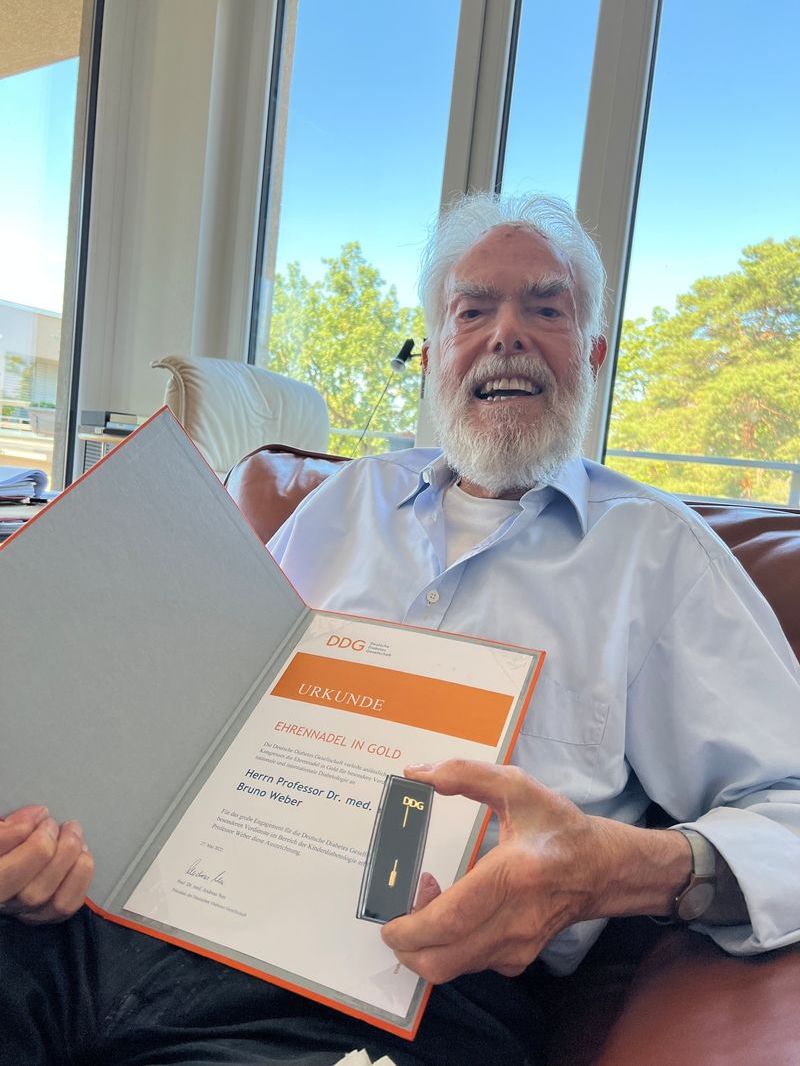
In Germany his contribution was recognised throughout his career. The German Society for Paediatrics and Adolescent Medicine awarded him the Adalbert Czerny Prize in 1970 for his habilitation thesis on plasma insulin in children. He was the first paediatrician elected to the board of the German Diabetes Association and became its President in 1981/82, devoting the 1982 annual meeting in Berlin to the psychosocial aspects of diabetes in children and adolescents. In 1997 he received the Paul Langerhans Medal; the title of his award lecture — “Diabetes mellitus in children: a permanent challenge for physicians and society” — captures his understanding of the profession exactly. In 2022 the Association awarded him its Gold Pin of Honour. For Bruno Weber, paediatric diabetology was never a purely medical undertaking; it demanded social responsibility, dependable structures of care, and a shared commitment to enabling affected children to lead lives as free and fulfilled as possible.
He was a generous teacher and mentor who placed his trust in younger colleagues, gave them room to grow, and encouraged them to find their own paths. His authority rested not on distance but on knowledge, experience, clarity and genuine personal warmth. Many of us owe decisive turns in our careers to him.
With Professor Bruno Weber we lose a founder of our Society and of our field, a deeply respected colleague, and for many of us a formative teacher and friend. His scientific work, his dedication to ISPAD and to academic reconciliation in the aftermath of the Second World War, and above all his attitude towards the children entrusted to his care will live on.
Our deepest sympathy goes to his family and to all those who were close to him.
His companions of many years around the world will remember “Monsieur Bruno”, as they affectionately called him, with great gratitude and deep affection.
Prof. Dr. Thomas Danne
On behalf of ISPAD